


NUS vs SIT Nursing: SIT Is Only for Registered Nurses. Myth or Fact?
Ask most people what SIT offers in nursing, and the answer, if they know anything at all, is usually the same: a degree for nurses who already hold a diploma and want to upgrade. That answer was correct for eight years. Since 2024, it has been incomplete, and the omission matters, because SIT now offers a genuine, direct-entry path into nursing that competes with NUS for exactly the same applicant.
The Programme Most People Have Heard Of
SIT's better-known nursing offering is a joint Bachelor of Science with Honours in Nursing, delivered with the University of Glasgow since January 2016. It is explicitly a post-registration degree, built for students who already hold a nursing diploma and are currently practising. It runs roughly one year and eight months to two years, accumulating 120 credits, and its purpose is to build on clinical experience these students already have, developing critical thinking, clinical leadership, research, and teaching skills a diploma alone does not cover.
The programme remains active today, accredited by the Singapore Nursing Board through November 2029, and its graduates post strong outcomes: a 96 percent employment rate in Singapore's own Graduate Employment Survey, with median gross salaries around S$3,800 to S$4,000. For a diploma-qualified nurse already working, this is a well-established, genuinely respected upgrade path.
It is also, on its own, not a fair comparison against NUS. A student choosing where to begin a nursing career for the first time was never SIT's applicant, for this particular programme, and NUS's Bachelor of Science in Nursing had no real rival at the point of first entry.
NUS's own programme is a 3-year Bachelor of Science (Nursing) degree, confirmed directly on the Alice Lee Centre's own programme page, with a 4th Honours year available to students who maintain a grade point average of 3.2 or higher. It accepts polytechnic diploma holders through an advanced-placement pathway, with the extent of credit granted reviewed case by case under NUS's own rules. The curriculum follows the SPICES model, student-centred, problem-based, integrated, community and hospital-based, with electives and a systematic approach to clinical education, a framework first set out by Harden and colleagues in 1984 and still the basis for how the programme structures its clinical practicum today.

What Changed in 2024
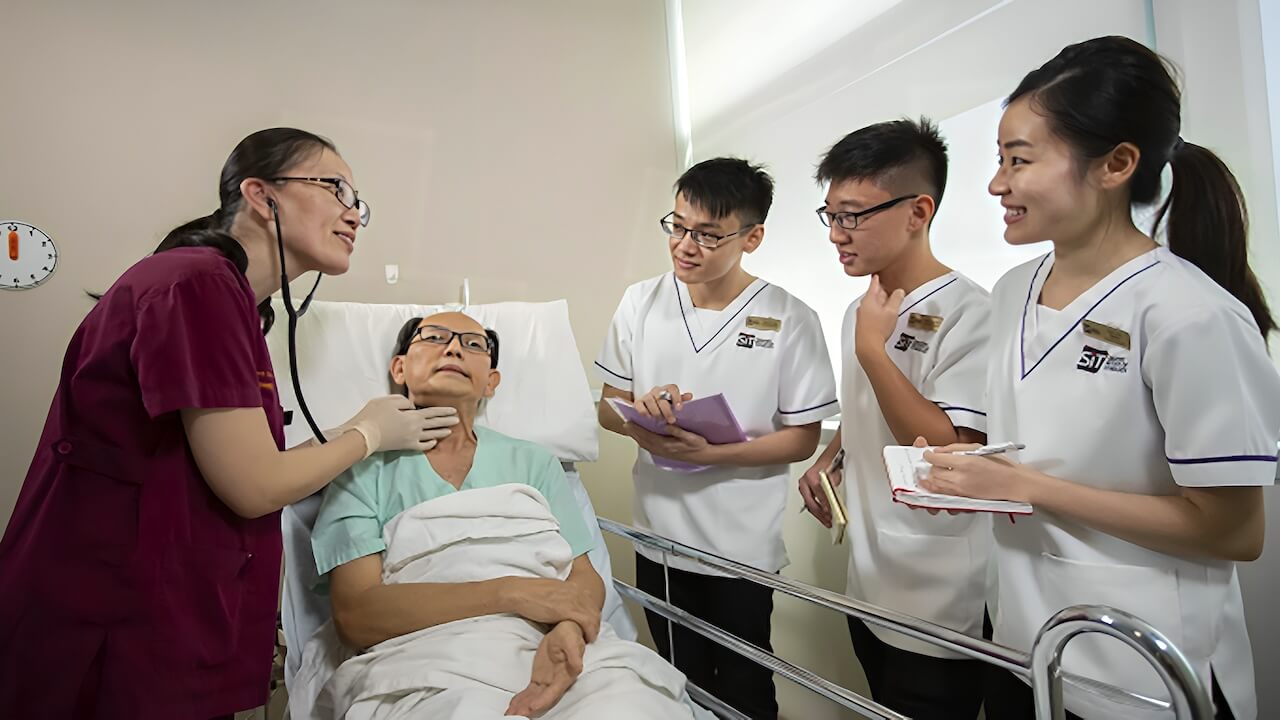
That changed with the SIT-SingHealth Integrated Bachelor of Science in Nursing and Master of Science in Nursing programme, a five-year pathway, 4 years and 8 months precisely, structured as 3 years toward the BSN followed by 2 years of specialty training toward the MSN, developed in direct collaboration with SingHealth and based at SIT's Punggol campus.
Unlike the Glasgow programme, this one accepts students with no prior nursing qualification at all: A-Levels, the International Baccalaureate, or equivalent international qualifications are all listed as valid entry routes, alongside relevant polytechnic diplomas. Its pioneer cohort was selected through an application window running from 8 January to 19 March 2024, evaluated holistically on academic record, co-curricular involvement, and demonstrated commitment to nursing, the same kind of criteria NUS itself uses for direct entrants.
This is a direct-entry pathway in every meaningful sense. An eighteen-year-old choosing where to study nursing now has a real second option in Singapore, one that did not exist before 2024, and treating SIT as exclusively a post-registration upgrade provider is no longer accurate.
A Genuinely Different Credential, Not Just a Newer One
The SIT-SingHealth programme is not simply a smaller-scale copy of NUS's degree. It is structured, from its first cohort onward, to award both a bachelor's and a master's degree across a single integrated five-year pathway, using a Term-In-Term-Out model that alternates campus learning with clinical residency at SingHealth institutions.
NUS's Bachelor of Science in Nursing is a standard undergraduate degree without a built-in postgraduate component; a graduate seeking a master's would pursue one separately, later, as an independent decision. SIT's newer pathway bakes that progression into the degree structure itself, producing, at completion, a nurse who already holds specialty-level postgraduate training that would otherwise take additional years to pursue after entering the workforce.
This is a real structural difference, not a marketing distinction. A family comparing the two is not choosing between a stronger and a weaker version of the same credential. They are choosing between an established bachelor's degree from an institution with two decades of accumulated academic reputation, and a newer, longer, integrated bachelor's-to-master's pathway built in direct partnership with one of Singapore's largest healthcare clusters.
Why Neither SIT Programme Appears in the Rankings
On the QS World University Rankings by Subject for Nursing 2026, NUS ranks 6th globally and 1st in Asia, with a perfect Employer Reputation score of 100.
Neither of SIT's nursing programmes appears in this ranking's tracked tier, for two different reasons. The Glasgow post-registration programme is a specialised, smaller-scale offering that was never positioned to compete on a subject ranking built around broad academic research output.
The SingHealth pre-registration programme is simply too new: its pioneer cohort, admitted in 2024, is still partway through a five-year degree and has not yet produced a single graduate, let alone the years of accumulated research and alumni reputation a subject ranking measures. NUS's ranking reflects two decades of the Alice Lee Centre for Nursing Studies, founded in March 2005; SIT's newest programme has existed for barely two.

What This Means for a Family Actually Choosing
For a student entering nursing for the first time, the comparison is no longer one-sided by default.
NUS offers the established, top-ranked, standard bachelor's pathway with two decades of institutional reputation behind it. SIT's SingHealth programme offers a longer, newer, integrated bachelor's-to-master's pathway with no ranking history yet to evaluate, built specifically around SingHealth's own clinical training environment.
Neither is the obviously correct choice; they are different bets on the same starting point, one backed by established reputation, the other by a credential structure that front-loads postgraduate training most nurses would otherwise pursue years into their career.
For a nurse who is already registered and diploma-qualified, the comparison this series usually runs simply does not apply. SIT's Glasgow programme remains the relevant option, a respected, accredited upgrade path NUS does not offer at all.
Comparison Table
Category | NUS (Bachelor of Science in Nursing) | SIT-SingHealth (Integrated BSN-MSN) | SIT-Glasgow (Post-Registration) |
|---|---|---|---|
QS Nursing (2026) | 6th globally, 1st in Asia | Not in tracked tier (too new) | Not in tracked tier |
Entry point | Pre-registration, first-time entry | Pre-registration, first-time entry | Post-registration, existing diploma nurses only |
Launched | Alice Lee Centre founded March 2005 | Pioneer cohort admitted 2024 | Launched January 2016 |
Credential | Bachelor's degree | Integrated Bachelor's + Master's | Bachelor's degree |
Duration | 3 years (BSc Nursing); 4 years with Honours (GPA 3.2+ required) | 4 years 8 months (3+2 structure) | 1 year 8 months to 2 years |
Entry qualifications | Junior college, polytechnic diploma | A-Levels, IB, or relevant polytechnic diploma | Existing nursing diploma required |
Professional recognition | Singapore Nursing Board registration | Singapore Nursing Board registration (expected) | SNB-accredited through November 2029 |
Bottom line: SIT is no longer only a post-registration upgrade provider. Since 2024, it has offered a genuine pre-registration pathway through SingHealth that competes directly with NUS for first-time nursing students, structured as an integrated bachelor's-to-master's degree rather than a bachelor's alone. NUS still holds the established ranking and two decades of reputation; SIT's newest programme is too young to have a ranking at all, but it is a real, structurally different rival, not a smaller version of the same thing.
Frequently Asked Questions
Does SIT only offer nursing degrees for nurses who are already registered?
No, not since 2024. SIT's long-running joint degree with the University of Glasgow is post-registration only, for existing diploma-qualified nurses. Since 2024, SIT has also offered an Integrated Bachelor of Science in Nursing and Master of Science in Nursing programme with SingHealth, which accepts first-time entrants with no prior nursing qualification.
What is the SIT-SingHealth nursing programme?
It is a five-year integrated degree, structured as three years toward a Bachelor of Science in Nursing followed by two years of specialty training toward a Master of Science in Nursing, developed with SingHealth and based at SIT's Punggol campus. Its pioneer cohort was admitted in 2024.
Why doesn't SIT's new nursing programme appear in the QS rankings?
It launched too recently. QS subject rankings measure accumulated research output and reputation over time. SIT's SingHealth programme admitted its first cohort in 2024 and has not yet produced a graduate, so it has not had time to build the track record a subject ranking evaluates.
Is SIT's integrated BSN-MSN programme a weaker option than NUS's degree?
Not necessarily weaker, structurally different. NUS's degree is a standard bachelor's programme with two decades of academic reputation behind it. SIT's newer programme takes longer but builds a master's-level specialty qualification into the degree itself, a credential structure NUS's basic nursing degree does not include.
Can a student with A-Levels or the IB apply directly to SIT's nursing programme?
Yes, for the SingHealth pathway specifically. SIT's Integrated BSN-MSN programme lists A-Levels, the International Baccalaureate, and equivalent international qualifications as valid entry routes, alongside relevant polytechnic diplomas, making it a genuine direct-entry option rather than a diploma-holder-only pathway.
Which nursing pathway should a first-time applicant choose?
It depends on what the student is optimising for. NUS offers the established, top-ranked standard degree with a long track record. SIT's SingHealth programme offers a longer pathway that front-loads a master's-level specialty qualification most nurses would otherwise pursue separately, years into their career, but without yet having a ranking history to evaluate.

Final Words on NUS and SIT Nursing
NUS's 6th-place ranking is a real, earned signal, two decades of the Alice Lee Centre producing nurses who now lead wards across Singapore's hospital system, and a curriculum model old enough to have a name and a citation attached to it. None of that makes SIT's newer pathway a lesser choice by default. It makes it a different one, built for a family that wants the postgraduate specialty training baked in rather than pursued years later, from a partner that already runs the hospitals its graduates will work in.
The honest caution for a family weighing this today is that SIT's programme has no ranking history at all, not a weak one, an absent one, because its pioneer cohort has not yet graduated. That is not a reason to dismiss it. It is a reason to ask SIT directly what its first cohort's placement outcomes look like once they exist, rather than assume a QS rank will ever tell that story on its own.
Source note: QS World University Rankings by Subject 2026 (Nursing) findings summarised from published rankings data. NUS Alice Lee Centre for Nursing Studies founding history verified against NUS Medicine's own published history and a Ministry of Health newsroom announcement (2 March 2006). The programme's 3-year duration, 4th Honours year (GPA 3.2+ threshold), diploma-holder advanced placement pathway, and SPICES curriculum model were confirmed directly against NUS Medicine's own Bachelor of Science (Nursing) programme page. SIT's Glasgow post-registration programme details, its continued active status and SNB accreditation through November 2029, and its 96 percent Graduate Employment Survey outcome, verified against SIT's own published programme information and a secondary source (AcademicJobs.com) citing the GES data directly. The SIT-SingHealth Integrated BSN-MSN programme's structure, 2024 pioneer cohort, admission requirements, and Term-In-Term-Out model were confirmed via SIT's own official programme page (singaporetech.edu.sg) and cross-referenced against Singapore's Ministry of Education CourseFinder listing. The SIT claims were confirmed via search-result summaries rather than direct page navigation during this research pass; they should still be spot-checked directly against singaporetech.edu.sg and moe.gov.sg before publishing, and links added once confirmed.