


NUS and NTU Are Top in Asia for Computer Science. But What the Rankings Don't Tell You
On the QS World University Rankings by Subject for Computer Science and Information Systems 2026, Singapore holds both of Asia's top two positions in the discipline: NUS ranks 4th globally, and NTU 9th, ahead of Tsinghua, Peking, and every other university on the continent. Verified directly against QS's own published dataset, this is not a close or contestable result. SMU, by comparison, sits at 124th in the same table, a real and substantial gap, though a genuine improvement from 139th the year before.
Read as a single number, this settles the question before it is asked: for a student choosing where to study computer science in Singapore, NUS and NTU are the two established, research-driven options, and SMU is a distant third. What that number cannot show is what actually happens inside SMU's specific Information Systems programme, because it was not built to compete on this measure in the first place, and on at least one narrower, more technical measure, it does not merely compete. It leads.
NUS Leads, and the Reasons Are Straightforward
NUS's 4th-place global standing is the product of a computing faculty, the School of Computing, that has been building research output, faculty reputation, and industry ties for decades. Its scores across the QS methodology are strong and consistent: high marks in academic reputation, employer reputation, and international research network breadth, the kind of broad-based strength that comes from sustained investment across every measured indicator rather than a single standout area.
For a student who wants the most comprehensively resourced computing education in Singapore, backed by the country's oldest and largest computing faculty, NUS is the straightforward, well-earned answer.
NTU's Position Is Real, Built on Its Own Institutional History
NTU's 9th-place standing, down from 6th the year before but still comfortably ahead of every university in Asia outside NUS, rests on a computing programme with genuine institutional depth.
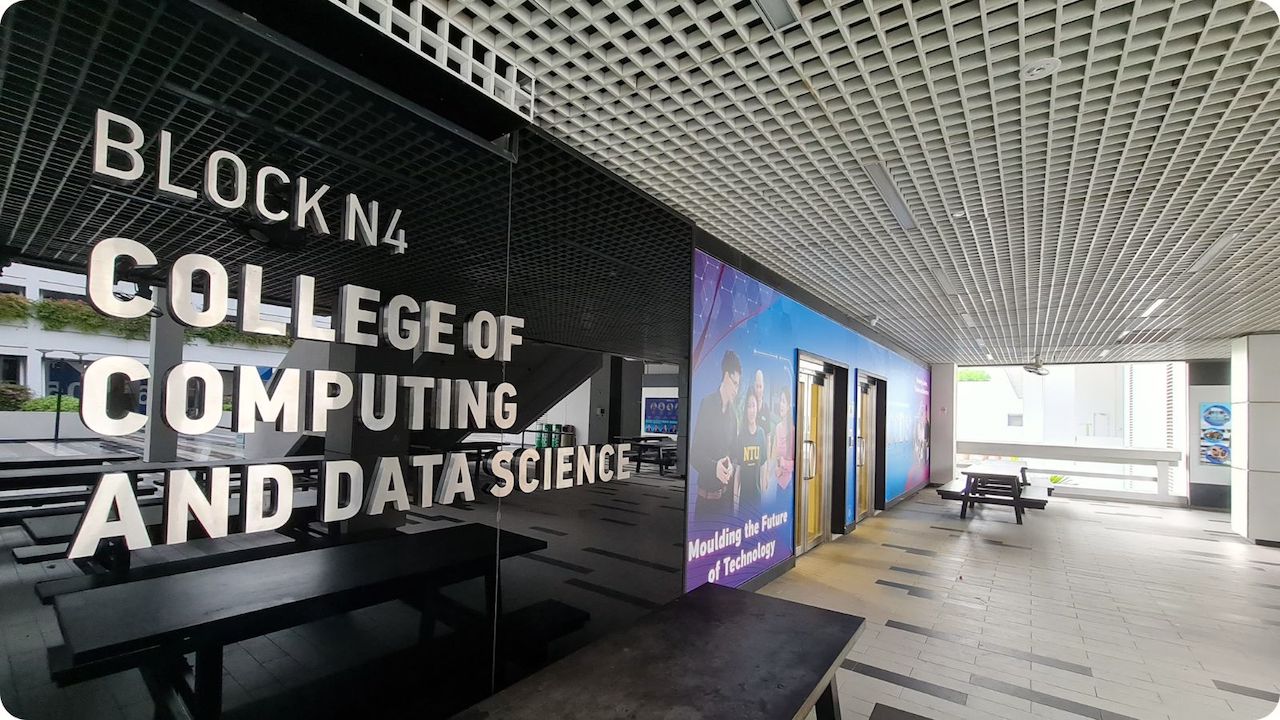
NTU's own computing lineage traces to 1988, when Nanyang Technological Institute set up its School of Applied Science and, the following year, introduced Computer Technology, Singapore's first computer engineering degree of any kind. That lineage grew through several transformations, renamed the School of Computer Science and Engineering in 2016, expanded with a dedicated Data Science and Artificial Intelligence programme in 2018, and consolidated in May 2024 into the College of Computing and Data Science, NTU's newest of six academic colleges.
Nearly four decades of being Singapore's original computing programme is not a marketing claim; it shows up directly in a global top-10 position that has held for years, even as this year's specific rank moved from 6th to 9th.
SMU Was Never Trying to Win This Particular Race
What SMU's School of Computing and Information Systems represents is a different kind of institution entirely, one built not to grow organically into computing the way NTU did, but constructed in direct partnership with an outside institution from its very founding.
In January 2003, SMU and Carnegie Mellon University signed a four-year strategic partnership with a specific, narrow purpose: helping SMU establish an entirely new School of Information Systems from the ground up. Carnegie Mellon faculty were directly involved in recruiting and developing SMU's own faculty, and in designing the undergraduate curriculum and course structure itself.
The partnership succeeded well enough that both universities extended it for a further four years in May 2007, this time expanding into postgraduate education, a research-focused PhD programme, and joint faculty research.
The most tangible result of that partnership is still running today. The SMU-Carnegie Mellon Masters Fast-Track Programme allows SMU computing students, across Information Systems, Computer Science, Computing & Law, and Software Engineering, to graduate within four to four and a half years holding both a Bachelor of Science from SMU and a master's degree in IT from Carnegie Mellon University, one of the most respected names in the field anywhere in the world.
A student who wants a Carnegie Mellon credential without a separate multi-year application process and a second full degree's worth of tuition abroad has, at SMU, a direct, structured pathway to exactly that, an option neither NUS nor NTU offers in the same form.
The partnership went further than teaching. In 2011, SMU and Carnegie Mellon jointly established the Living Analytics Research Centre, a S$60 million facility positioned to make Singapore a global centre of excellence in computational social science, combining large-scale data mining, statistical machine learning, and the analysis of dynamic social networks with research into consumer behaviour and social media. The centre is physically anchored at SMU's own School of Information Systems in Singapore and at Carnegie Mellon's Heinz College iLab in Pittsburgh, giving SMU students proximity to a genuinely global research operation neither of Singapore's higher-ranked computing faculties offers through an equivalent joint structure.
None of this shows up as a line item in a QS subject score. Research citations and employer surveys measure accumulated output over years; they do not measure whether a specific curriculum was designed in direct partnership with one of the field's most respected institutions, or whether a dual-degree pathway to that institution's own master's programme exists at all.

What does show up, on a different QS measure entirely, is a real signal that the partnership works. SMU's Master of IT in Business, the postgraduate programme most closely tied to this Carnegie Mellon collaboration, ranked 2nd in Asia and 25th worldwide in the QS Master's in Business Analytics Rankings 2026, confirmed directly by SMU's own newsroom, scoring above the global average on every evaluated indicator.
This is a different QS ranking product from the Computer Science and Information Systems subject table above, one specifically for postgraduate business analytics programmes, so it is not a direct substitute for NUS and NTU's undergraduate-facing standing. But it is real, current, independently verified evidence that the specific programme built around the Carnegie Mellon partnership is not simply an interesting historical footnote. It is a postgraduate degree performing near the top of its actual category, globally.
The One Sub-Field Where SMU Genuinely Leads All Three
A separate ranking system altogether reveals something more striking, and it is not a story about SMU catching up to NUS or NTU. It is a story about SMU leading both of them, on a genuinely different measure.
CSRankings, a metrics-based system that evaluates computer science institutions specifically by their publications at top-tier research conferences rather than by reputation surveys, placed SMU 2nd in the world for Software Engineering in its 2023 edition, up from 4th the year before, and SMU held that 2nd-place position into the 2024 edition as well.
SMU's own newsroom states it was the only Singapore university to appear in CSRankings' global top 10 for the subject that year, a claim that would place SMU ahead of both NUS and NTU in this specific sub-field, though this was not independently checked against either university's own CSRankings position during this research pass. The company SMU kept at 2nd place is worth naming directly: it sat ahead of Carnegie Mellon University itself, ranked 7th in the same 2023 list, the very institution that helped build SMU's computing school in the first place.
A separate bibliometric study from the University of Texas at Dallas, covering publications from 2013 to 2020, independently placed SMU 5th worldwide in software engineering research, in the company of Carnegie Mellon, Nanjing University, and Microsoft Research.
This achievement sits behind SMU's Centre for Research in Intelligent Software Engineering, known as RISE, Singapore's only research centre dedicated specifically to software engineering, led by Professor David Lo. It is a genuinely different kind of evidence from the broad subject table above: a specialised, publication-based measure that isolates one specific sub-field the general Computer Science and Information Systems ranking does not break out separately, and on that narrower, more technical measure, SMU is not the distant third its 124th-place overall standing would suggest.
It may be the strongest of the three…

What This Actually Means for a Prospective Student
For a student who wants the broadest, most established computing education in Singapore, backed by decades of accumulated research reputation across every measured indicator, NUS's 4th-place global standing is the clearest, best-supported answer available.
For a student who wants that same kind of broad institutional strength but is drawn to NTU's specific engineering-adjacent history and its newly consolidated College of Computing and Data Science, NTU's 9th-place standing, still comfortably ahead of every other Asian university outside NUS, is a genuinely strong second option.
For a student specifically weighing the practical route into a Carnegie Mellon credential, drawn to a curriculum designed collaboratively with one of the most respected computer science institutions in the world, or interested specifically in software engineering research at a level that appears to outrank both of Singapore's higher-placed universities, SMU's Fast-Track programme, its Carnegie Mellon partnership, and its CSRankings standing are a genuinely different kind of value proposition, one a broad subject ranking was never built to capture.
None of these three answers is more correct than the others in the abstract. They measure different things, and a family that stops at the first number on the table risks missing the specific strength that might matter most for their own child.
Comparison Table
Category | NUS | NTU | SMU |
|---|---|---|---|
QS Computer Science and Information Systems (2026) | 4th globally, 1st in Asia | 9th globally, 2nd in Asia (2025: 6th) | 124th globally (2025: 139th) |
Origins in computing | School of Computing, long-established, comprehensive faculty | 1988-89, Singapore's first computer engineering degree; became College of Computing and Data Science, May 2024 | School of Information Systems, curriculum co-developed with Carnegie Mellon from founding, 2003 |
Key partnership | None of comparable scale in this subject | None of comparable scale in this subject | Formal SMU-Carnegie Mellon partnership, January 2003, extended 2007 |
Dual-degree pathway | Not built around an equivalent structured pathway | Not built around an equivalent structured pathway | SMU-CMU Fast-Track: SMU bachelor's plus a Carnegie Mellon master's in IT, in 4 to 4.5 years |
QS Master's in Business Analytics (2026), MITB programme | Not applicable, different degree category | Not applicable, different degree category | 2nd in Asia, 25th worldwide |
CSRankings Software Engineering (2023-2024) | Not confirmed during this research pass | Not confirmed during this research pass | 2nd worldwide, ahead of Carnegie Mellon University itself (7th) |
Bottom line: NUS and NTU hold Asia's top two positions in Computer Science and Information Systems, 4th and 9th globally, a genuine, verified, and substantial lead over SMU's 124th in the same 2026 QS subject table. That gap is real and should not be minimised. But it is also not the whole story.
SMU's Information Systems school was built in direct partnership with Carnegie Mellon from its founding, producing a structured path to a Carnegie Mellon master's degree in as little as four years, and on the one measure that isolates software engineering research specifically, CSRankings, SMU ranked 2nd worldwide, ahead of Carnegie Mellon itself and, by its own account, ahead of both NUS and NTU in Singapore.
Which of the three matters most depends on whether a family is optimising for the broadest available number or the specific strength underneath it.

Frequently Asked Questions
Are NUS and NTU really the top two universities in Asia for Computer Science?
Yes. On the QS World University Rankings by Subject for Computer Science and Information Systems 2026, NUS ranks 4th globally and NTU 9th, verified directly against QS's own published dataset, both ahead of every other Asian university including Tsinghua (11th) and Peking (16th).
Why does NTU's position matter even though it dropped from 6th to 9th this year?
NTU's 9th-place standing in 2026 is down from 6th in 2025, but it remains the second-highest ranked university in Asia for the subject, well ahead of every institution outside NUS. A single year's movement within the top 10 does not erase nearly four decades of institutional history dating to Singapore's first computer engineering degree in 1989.
Why is SMU so far behind on this specific ranking?
SMU ranks 124th globally in the same 2026 QS subject table, an improvement from 139th the year before but still far behind NUS and NTU. SMU's Information Systems school is younger and structured differently, built through a partnership with Carnegie Mellon rather than grown organically as a large comprehensive computing faculty, which affects the kind of broad, accumulated research output this particular ranking measures.
Is SMU's computing programme really built with Carnegie Mellon?
Yes. SMU and Carnegie Mellon signed a formal four-year strategic partnership in January 2003 specifically to help SMU establish its School of Information Systems, with Carnegie Mellon faculty directly involved in curriculum design and faculty development. The partnership was extended for a further four years in 2007.
Is SMU actually stronger than NUS and NTU in any part of computing research?
In one specific, well-documented sub-field, quite possibly, yes. CSRankings, a publication-based ranking system, placed SMU 2nd worldwide for Software Engineering in 2023, a position it held into 2024, ahead of Carnegie Mellon University itself at 7th. SMU's own newsroom states it was Singapore's only university in the global top 10 for the subject that year, which would place it ahead of both NUS and NTU here, though this was not independently checked against either university's own CSRankings standing.
Which university should a prospective computing student choose?
It depends on what the student values. NUS offers the broadest, most established computing education in Singapore. NTU offers a similarly comprehensive faculty with its own deep institutional history, still Asia's second-ranked. SMU offers a curriculum co-developed with Carnegie Mellon, a structured pathway to a Carnegie Mellon master's degree, and a specific, independently verified strength in software engineering research that may outrank both of Singapore's more broadly ranked universities.

Final Words on NUS, NTU, and SMU Computer Science
A single ranking number is a compression, and compression always discards something. NUS's 4th place and NTU's 9th are not manufactured; they reflect decades of faculty growth, publication volume, and reputation that took real time to build, and neither university should have that discounted in service of a tidier story about the underdog. But the same compression that makes NUS and NTU look like the obvious answer also makes SMU look like an afterthought, and the Carnegie Mellon partnership, the Fast-Track master's pathway, and a software engineering research standing that appears to outrank both of Singapore's higher-placed universities say otherwise.
The honest reading is not that one number is wrong and another is right. It is that "strongest in computer science" was never a single question to begin with, and a family that lets the QS table answer it alone will miss whichever of these three strengths actually matters for the student in front of them.
Source note: NUS's, NTU's, and SMU's QS Computer Science and Information Systems 2026 positions (4th, 9th, and 124th respectively, with 2025 comparisons of 4th, 6th, and 139th) were verified directly against QS's own official public dataset (2026 QS World University Rankings by Subject, Computer Science & Information Systems sheet), including a direct check that NUS and NTU are Asia's top two universities in the subject, ahead of Tsinghua, Peking, and every other Asian institution in the same dataset. An earlier draft of this article omitted NUS entirely and incorrectly stated NTU's rank as 6th (its 2025, not 2026, position); both have been corrected. SMU's Master of IT in Business ranking (2nd in Asia, 25th worldwide, QS Master's in Business Analytics 2026) was confirmed directly via SMU's own newsroom, dated 17 September 2025, and is a different QS ranking product from the subject table above. SMU's CSRankings Software Engineering position (2nd worldwide, 2023 and 2024 editions) was confirmed across multiple sources including SMU's own newsroom, PRNewswire, and an independent third-party site (sgschoolkaki.com) referencing the 2024 edition; the claim that SMU was Singapore's only university in the global top 10 for this subject came from SMU's own source and was not independently cross-checked against NUS's or NTU's own CSRankings positions. The SMU-Carnegie Mellon partnership details (January 2003 agreement, 2007 extension, Fast-Track programme structure, and the Living Analytics Research Centre) and NTU's own 1988-89 founding history were confirmed across multiple consistent sources, including SMU's and NTU's own official pages and Carnegie Mellon's own official news pages, and are considered reliably verified.